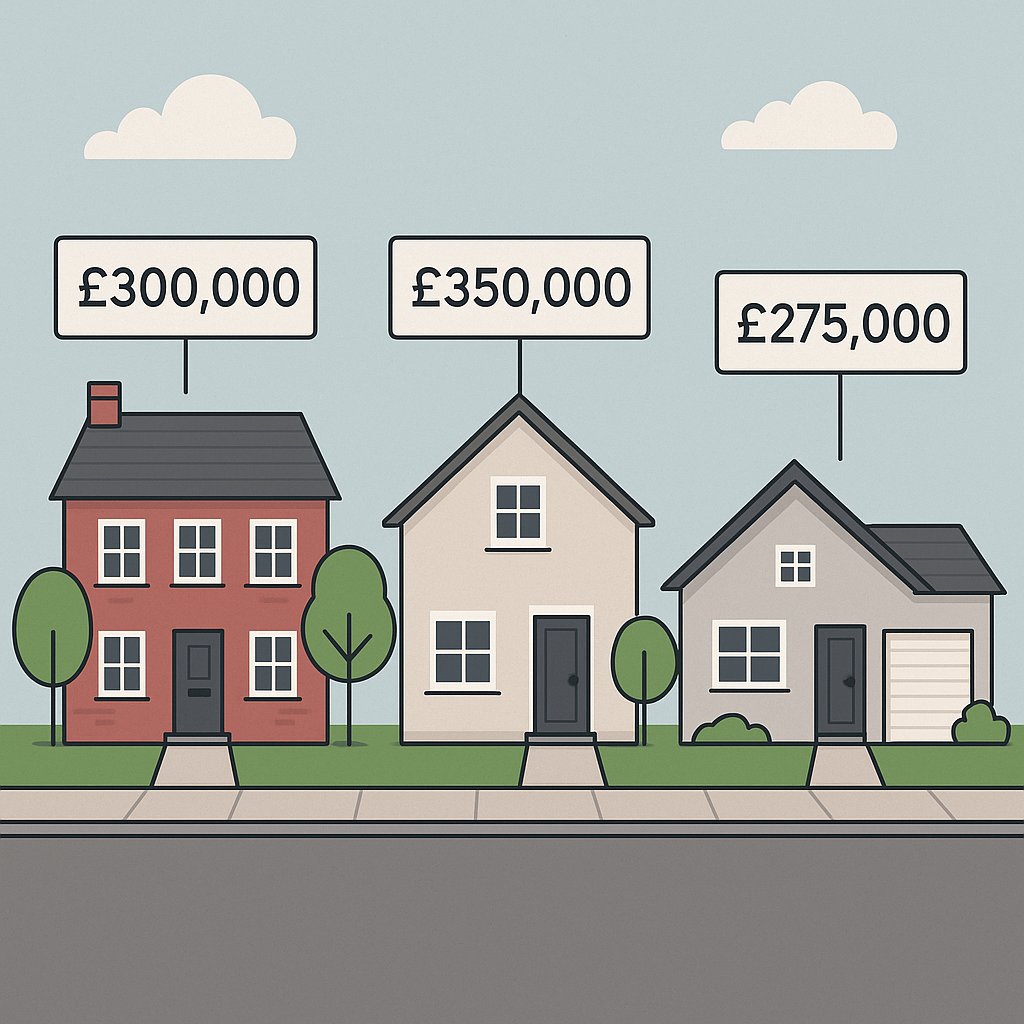
If someone offers to buy your Metro Atlanta home directly for cash, the biggest question is not simply whether the offer is “good.” The deeper question is whether you are comfortable accepting one buyer's valuation without first giving the broader market an opportunity to compete for the property. For some Sellers, speed, certainty, privacy, and convenience are worth more than additional market exposure. For others, giving up price discovery too early can be expensive.
Sell My House Fast in Metro Atlanta: Cash Offer or Open-Market Listing?
The real decision is not simply cash versus listing. It is certainty today versus the opportunity to discover what the broader market may pay.
A Direct Cash Offer
Tells You What
One Buyer Is Willing to Pay.
The Open Market
Gives You a Chance to Learn
What the Market Is Willing to Pay.
What Is Market Price Discovery?
Price discovery is the process of exposing a property to relevant buyers and observing how the market responds.
That response can include:
- Online interest.
- Showing activity.
- Buyer feedback.
- Repeat showings.
- Questions from buyer agents.
- Written offers.
- Competing offers.
- Negotiation behavior.
A Seller who accepts a direct offer before broad market exposure may choose:
certainty before price discovery.
That can be perfectly rational.
But it should be a conscious trade.
The question is not whether every listed home sells for more than a direct cash offer. It does not. The question is whether you are being compensated enough to give up the opportunity to find out.
Use the Market Price Discovery Test
Potential Open-Market Value
−
Preparation Cost
−
Carrying Cost
−
Selling Costs
−
Likely Concessions
−
Time / Execution Risk
vs.
Direct Cash Offer
−
Direct-Sale Costs
−
Remaining Contract Risk
Before Giving Up Market Exposure, Ask:
“How Much Market Exposure Do I Need Before I Am Comfortable That I Am Not Selling Below What This Property Could Realistically Command?”
1. A Direct Cash Offer Is Usually a Private Valuation
A direct buyer generally evaluates the property based on that buyer's own strategy.
Depending on the buyer, that may include:
- Current property condition.
- Expected repair costs.
- Renovation costs.
- Holding costs.
- Financing or capital costs.
- Resale risk.
- Desired profit.
- Target closing timeline.
That buyer may make an excellent offer.
But the offer still represents:
that buyer's economics.
It does not automatically prove what:
an owner-occupant,
another investor,
a renovation-minded buyer,
or multiple competing buyers
might pay.
One Offer
Is
One Data Point.
It Is Not Automatically
the Market.
2. An Open-Market Listing Creates a Price-Discovery Process
When a home is professionally prepared, priced, and exposed to the broader buyer pool, Seller can observe:
whether buyers click,
whether they schedule showings,
whether they return,
whether they write offers,
and whether more than one buyer is willing to compete.
This creates information.
But it does not create a guarantee.
Market exposure may reveal:
that buyers are willing to pay substantially more than a direct offer.
It may also reveal:
that the direct offer was already competitive.
Open-market exposure does not guarantee a higher price. Its value is that it allows more buyers to participate in determining the price.
3. Convenience Has Economic Value
A Seller may reasonably prefer:
- No staging.
- No repeated showings.
- No open houses.
- No major repairs.
- No mortgage-financing dependency.
- A faster proposed closing.
- A more private transaction.
Those benefits have value.
The question is:
how much?
Suppose a direct buyer offers:
$430,000.
Seller estimates a realistic open-market result around:
$475,000.
After projected selling costs, preparation, concessions, and carrying costs, Seller estimates an open-market net of:
$452,000.
The practical difference may be around:
$22,000.
Now Seller has a much better question:
“Would I knowingly pay approximately $22,000 for the speed and convenience this direct sale offers me?”
Convenience
Should Not Be Treated as
Free.
Put a Number on It.
4. Compare Net-to-Net, Not Offer-to-Offer
Seller should not compare:
$430,000 cash offer
with:
$475,000 possible listing price.
Those are not equivalent numbers.
Instead:
Open-Market Estimated Net
=
Expected Sale Price
− Brokerage Compensation
− Seller-Paid Costs
− Preparation / Repair Expense
− Negotiated Credits
− Carrying Cost
− Other Transaction Expenses
Then:
Direct-Sale Estimated Net
=
Direct Offer
− Seller-Paid Fees or Costs
− Other Contract-Specific Expenses
Use actual written numbers whenever available.
Broker compensation should be based on the actual negotiated agreement—not an assumed “standard” percentage.
5. “As-Is” Does Not Automatically Mean “Investor Only”
A Seller may think:
“My house needs work, so my only option is a cash investor.”
Not necessarily.
An open-market listing can also be marketed in its current condition.
Potential buyers may include:
- Owner-occupants willing to renovate.
- Investors.
- Cash buyers.
- Financed buyers whose financing works with the property's condition.
The important question is:
“Is the property's condition compatible with the likely buyer pool and financing options?”
That requires property-specific analysis.
“Sell as-is” describes the Seller's preparation strategy. It does not automatically determine who the Buyer must be.
6. Don't Over-Renovate Just to Earn the Right to List
Seller does not need to make every house perfect before market exposure.
Separate projects into:
Category | Seller Question |
|---|---|
Must Address | Could this materially limit the buyer pool or financing options? |
High-Impact Cosmetic | Can a relatively modest improvement materially improve buyer perception? |
Optional Improvement | Is the likely market benefit worth the time and cost? |
Leave for Buyer | Would I be spending money primarily on personal taste rather than marketability? |
7. Time Has a Dollar Value
If keeping the property costs:
$4,000 per month
in mortgage, taxes, insurance, utilities, HOA, maintenance, and other carrying expenses,
then an additional two months could represent approximately:
$8,000 in carrying cost.
That does not mean the property will take two extra months to sell.
It simply gives Seller a way to calculate the cost of time.
Waiting Has a Cost.
Selling Too Quickly
Can Also Have
a Cost.
8. Your Hard Deadline Changes How Much Price Discovery You Can Afford
Seller A would like to move within three months.
Seller B must close before a specific relocation deadline.
Those Sellers should not use the same strategy.
Think of the deadline in three categories:
- Preferred: I would like to close by this date.
- Important: Missing the date creates meaningful inconvenience or cost.
- Non-Negotiable: Missing the date creates an unacceptable financial or logistical problem.
The harder the deadline:
the more valuable closing certainty can become.
9. Market Exposure Does Not Have to Mean Waiting Forever
Some Sellers imagine that choosing a traditional listing means:
months of uncertainty with no fallback plan.
That is not necessarily the strategy.
A Seller can create a written decision framework before launching.
For example:
- What showing activity would indicate healthy demand?
- What buyer feedback would be meaningful?
- What competing listings should be monitored?
- When will pricing be reviewed?
- What market evidence would justify changing strategy?
- What is Plan B if the property does not perform as expected?
There is no universal number of days or showings that automatically triggers a change.
The review should be based on:
property-specific and market-specific evidence.
Price discovery works best when Seller defines the review process before frustration takes over.
10. A “Cash Offer” Still Needs Due Diligence
Cash eliminates traditional mortgage-financing dependency.
It does not eliminate:
- Contract risk.
- Buyer termination rights.
- Inspection provisions.
- Title issues.
- Assignment provisions.
- Closing delays.
- Renegotiation attempts.
Before Seller gives up market exposure, ask:
- Who is the actual Buyer?
- Can Buyer provide proof of funds?
- Is Buyer purchasing with its own funds?
- Can the contract be assigned?
- What Due Diligence or inspection rights remain?
- What termination rights remain?
- What fees will Seller pay?
- When is earnest money due?
- What is the exact proposed closing date?
“Cash”
Means
No Mortgage Dependency.
It Does Not Mean
No Contract Risk.
11. Ask Whether the Direct Offer Is Really the Final Number
A Seller receives:
$425,000 cash.
Seller thinks:
“At least I know exactly what I'm getting.”
Maybe.
But if the contract permits:
inspection,
Due Diligence,
termination,
or later renegotiation,
then Seller should understand:
how much of the $425,000 is actually locked in at signing.
A direct offer should not receive a “certainty premium” unless the contract actually provides meaningful certainty.
12. Ask What You Are Giving Up by Selling Privately
When you accept a direct offer before going to market, you may be giving up:
- Exposure to owner-occupant Buyers.
- Exposure to other investors.
- Potential multiple-offer competition.
- Buyer feedback.
- Evidence of how buyers respond to your pricing.
- The possibility that a specific Buyer values your property more than an investor model does.
That does not make the direct offer wrong.
But Seller should identify:
what option is being surrendered in exchange for speed.
Every Direct Sale Has
an Invisible Question:
“What Is the Buyer Paying Me to Give Up Competition?”
13. The Value of Price Discovery Depends on the Property
Open-market exposure may have more value when the home:
- Appeals to a broad owner-occupant buyer pool.
- Has attractive condition or presentation.
- Is in a competitive price bracket.
- Has features that different buyers may value differently.
- Is difficult to value using a simple investor formula.
A direct sale may become relatively more attractive when:
- The property requires substantial work.
- Access for showings is difficult.
- Seller has an unusually hard deadline.
- Privacy is especially important.
- Tenant occupancy materially complicates marketing.
- Preparation costs are substantial relative to potential upside.
These are considerations.
Not automatic rules.
14. Tenant-Occupied Properties Need a Different Exposure Analysis
A tenant-occupied property may create:
- Showing restrictions.
- Notice requirements.
- Presentation limitations.
- Lease-related obligations.
- A buyer pool that differs from a vacant or owner-occupied home.
But tenant occupancy does not automatically mean Seller should sell directly to an investor.
First determine:
- Current lease terms.
- Current rent.
- Who the likely buyer pool is.
- How easily the property can be shown.
- Whether owner-occupant Buyers are realistically available under the circumstances.
- Whether investors in the open market may compete for the property.
15. Inherited, Vacant, or Distressed Properties Still Need a Net Comparison
A vacant or inherited property can create pressure to simplify the transaction.
Seller may be dealing with:
maintenance,
insurance,
utilities,
property taxes,
distance,
or estate administration.
Those burdens are real.
But do not convert:
“I don't want to deal with this property”
into:
“therefore any fast offer is financially reasonable.”
Quantify the inconvenience.
16. Metro Atlanta Is Too Large for a County Name to Determine the Strategy
Fulton,
Gwinnett,
Cobb,
Forsyth,
and DeKalb
each contain multiple property types, price brackets, municipalities, school assignments, commute patterns, and micro-markets.
For example, a Seller should not assume:
“The market is slow in Cobb, so my Smyrna townhouse should be sold directly.”
Or:
“Gwinnett has strong demand, so my property will automatically get multiple offers.”
The analysis should move down to:
- Exact location.
- Property type.
- Price bracket.
- Condition.
- Current inventory.
- Relevant recent sales.
- Direct competing listings.
- Current buyer response.
County-level data gives context. Seller strategy should be built at the property's actual competitive level.
17. In a More Negotiated Market, Price Discovery Needs Good Positioning
Market exposure alone is not enough.
If Seller goes to market at a price that Buyers do not consider competitive,
the Seller may receive:
traffic without offers,
weak traffic,
or price-reduction pressure.
The benefit of listing is not:
“put it online and wait for the highest possible number.”
The benefit is:
“position it intelligently enough that relevant buyers participate in the price-discovery process.”
18. Overpricing Can Destroy the Information You Were Trying to Obtain
Suppose a property's realistic competitive range is around:
$500,000.
Seller lists at:
$575,000.
Then receives weak activity.
Seller may conclude:
“The open market doesn't want my house.”
But the market may actually be saying:
“We do not want it at this positioning.”
Price Discovery
Only Works
When Buyers Believe
the Property Is Worth Evaluating.
19. “Price Low and Let Buyers Bid It Up” Is Not a Universal Rule Either
Strategic pricing can create competition.
But Seller should not assume:
a low list price guarantees multiple offers.
If Buyer demand is weaker than expected,
Seller may simply receive offers around the lower number.
Pricing strategy should reflect:
- Current demand.
- Comparable sales.
- Active competition.
- Buyer search behavior.
- Property condition.
- Seller's risk tolerance.
20. Early in the Process, Seller Has More Option Value
Before choosing a path, Seller may have several options:
- Accept a direct offer.
- Negotiate the direct offer.
- Prepare and list publicly.
- List as-is.
- Make limited targeted improvements.
- Delay temporarily if timing allows.
Once Seller signs a binding agreement:
some of those options may disappear.
That is why early decision quality matters.
The most valuable time to compare your options is before you contractually give them up.
21. Benchmark a Direct Offer Against a Realistic Market Scenario
Do not ask your agent:
“What's the absolute highest number I could possibly get?”
Ask for:
- A realistic market-supported range.
- A preparation recommendation.
- Expected selling costs.
- Likely buyer profile.
- Current direct competitors.
- Estimated carrying timeline.
- Estimated Seller net under reasonable scenarios.
Then compare that with the written direct offer.
22. Use Three Open-Market Scenarios Instead of One Fantasy Number
Scenario | What to Estimate |
|---|---|
Conservative | What if demand is weaker or negotiations are heavier than expected? |
Expected | What is the most supportable outcome based on current evidence? |
Strong-Market Response | What could happen if the property generates unusually strong competition? |
Compare the direct offer against all three.
This makes the decision less dependent on:
one optimistic sales-price estimate.
Direct Sale vs. Open-Market Price Discovery Matrix
Factor | Direct Cash Offer | Open-Market Listing |
|---|---|---|
Price Discovery | Primarily one buyer's valuation | Broader buyer participation |
Preparation | May be limited | Can range from as-is to full preparation |
Showings | Often fewer | Typically requires buyer access |
Mortgage Dependency | None if Buyer truly uses cash | Depends on selected Buyer |
Potential Buyer Competition | Usually limited | Possible, not guaranteed |
Timeline | Can potentially be shorter | Depends on preparation, market response and selected Buyer |
Certainty | Depends on actual contract rights and Buyer capacity | Depends on selected offer and contingencies |
Main Trade-Off | Potentially gives up broader price discovery | Requires time and execution to discover market value |
The 100-Point Market Price Discovery Scorecard
Category | Weight | Seller Question |
|---|---|---|
Direct-Offer Economics | ___ / 20 | How strong is the actual net offer available today? |
Open-Market Upside | ___ / 20 | How much supportable net upside might broader exposure create? |
Deadline Flexibility | ___ / 15 | How much time can I realistically devote to price discovery? |
Preparation Burden | ___ / 10 | How difficult or expensive is it to prepare this property? |
Carrying Cost | ___ / 10 | What does each additional month actually cost? |
Direct-Buyer Certainty | ___ / 10 | How much certainty does the written contract truly provide? |
Convenience Value | ___ / 10 | How much is reduced preparation and disruption worth to me? |
Fallback Flexibility | ___ / 5 | If Plan A fails, how much time and optionality remain? |
Total | ___ / 100 | This is a decision tool—not a prediction of sale price or closing. |
30 Questions Before Accepting a Direct Cash Offer
☐ 1. Who is the actual Buyer?
☐ 2. Can Buyer provide proof of funds?
☐ 3. Is Buyer using its own cash?
☐ 4. Is the contract assignable?
☐ 5. What Due Diligence rights remain?
☐ 6. What inspection rights remain?
☐ 7. What termination rights remain?
☐ 8. When is earnest money due?
☐ 9. What happens if Buyer fails to close?
☐ 10. What is the exact proposed closing date?
☐ 11. Which Seller-paid fees are included?
☐ 12. What is my estimated direct-sale net?
☐ 13. What relevant comparable sales support the property?
☐ 14. What are the strongest current competing listings?
☐ 15. What is a realistic open-market sale-price range?
☐ 16. What is a realistic open-market net?
☐ 17. How much preparation would a listing actually require?
☐ 18. Could we list as-is instead?
☐ 19. What repairs truly affect marketability?
☐ 20. What repairs are optional?
☐ 21. What does each additional month cost me?
☐ 22. Is my deadline preferred, important, or non-negotiable?
☐ 23. How broad is the likely open-market buyer pool?
☐ 24. Does this property have features an owner-occupant might value more than an investor?
☐ 25. What would Plan B be if the listing does not perform as expected?
☐ 26. How much convenience am I receiving from the direct sale?
☐ 27. What dollar amount would I willingly pay for that convenience?
☐ 28. Is the current direct offer really final, or can the economics still change?
☐ 29. What opportunity am I giving up by not exposing the property to other Buyers?
☐ 30. How much market exposure do I need before I am comfortable giving that opportunity up?
The Question That Changes the Cash-vs.-Listing Decision:
“What Am I Being Paid to Give Up by Accepting This Direct Offer Today?”
Frequently Asked Questions
Is selling to a cash buyer always faster?
No. Removing mortgage-financing dependency can shorten part of the process, but title work, Due Diligence, inspections, Buyer contract rights, Seller obligations, and closing preparation can still affect the timeline.
Does a cash buyer always pay less?
No. Some direct cash offers may be highly competitive. Other buyers may price repairs, resale risk, holding costs, or profit into their offers. Compare the actual written offer with a realistic open-market net analysis.
Can I list my Metro Atlanta home as-is?
Potentially, yes. “As-is” does not automatically mean a property must be sold directly to an investor. Buyer interest and financing feasibility will depend on the property's actual condition and contract structure.
Is an open-market listing guaranteed to make me more money?
No. A listing provides broader exposure and an opportunity for price discovery. It does not guarantee a higher offer, higher Seller net, multiple offers, or a particular timeline.
How do I know whether a cash offer is fair?
Compare it with relevant recent sales, current competition, a realistic open-market sale range, estimated open-market net, preparation cost, carrying cost, transaction risk, and the value you personally place on speed and convenience.
What if I do not want people coming through my home?
That convenience has real value. A direct sale may reduce showing disruption. The decision becomes whether the financial difference between the direct offer and a realistic open-market outcome is worth paying for that convenience.
Can a cash Buyer lower the price after I sign?
Whether the economics can change depends on the actual contract and any Buyer rights that remain. Review Due Diligence, inspection, termination, assignment, amendment, and other relevant provisions before treating the original number as final.
Can I first list the property and later consider a cash Buyer?
Possibly, but once a Seller enters a listing agreement or another binding contract, those documents may create obligations. Review the applicable agreement before changing strategies.
Are brokerage commissions standard?
No. Broker compensation is not set by law and is negotiable. Seller net estimates should use the actual compensation and other costs agreed to in the transaction.
What is the best question to ask before selling directly?
Ask: “What am I being paid to give up by accepting this direct offer before exposing the property to other Buyers?”
Direct Sale
Buys
Speed and Convenience.
Open-Market Exposure
Buys
Price Discovery.
The Right Strategy Depends on
What Each Is Worth to You.
Final Thoughts: Know What You Are Trading Before You Choose Speed
A direct cash offer can be the right answer.
An open-market listing can be the right answer.
Neither strategy is automatically superior.
Before deciding, calculate:
Direct-offer net.
Realistic open-market net.
Preparation cost.
Carrying cost.
Seller timeline.
Buyer contract rights.
Closing certainty.
Convenience value.
And the market opportunity you would be giving up.
Then ask:
“Am I choosing the direct offer because it is truly the strongest outcome—or because I never measured what broader market exposure could be worth?”
You do not need to maximize price at the expense of everything else.
But if you choose speed, convenience, or certainty over market exposure, understand exactly what you are receiving—and exactly what you may be giving up.
Received a Cash Offer on Your Metro Atlanta Home?
Before accepting it, we can compare the written direct offer with a realistic open-market scenario using recent comparable sales, current competing listings, property condition, preparation options, estimated Seller net, carrying cost, likely buyer pool, contract terms, and your actual deadline. The goal is not to push every Seller toward a traditional listing or toward a cash sale. It is to make sure you understand the value of the option you are choosing—and the option you are giving up.
Tina Jingru Sui | TJS Team
Call or Text: (404) 375-2120
Email: [email protected]
Visit TinaSui.com
About Tina Jingru Sui
Tina Jingru Sui is the founder and leader of the TJS Team, serving home sellers, buyers, investors, new-construction buyers, and relocation clients throughout Metro Atlanta.
Tina and her team serve Fulton, Gwinnett, Cobb, Forsyth, and DeKalb counties, including Atlanta, Johns Creek, Alpharetta, Suwanee, Duluth, Buford, Dacula, Sandy Springs, Roswell, Marietta, Smyrna, Peachtree Corners, and surrounding Metro Atlanta communities.
2026 Market & Consumer Note
Metro Atlanta market conditions vary substantially by municipality, neighborhood, property type, condition, and price range. Broad regional statistics should be used as context rather than as a substitute for a property-specific Comparative Market Analysis. Brokerage compensation and fees for brokerage services are negotiable and should be based on the parties' actual written agreements.
Keller Williams Realty Atlanta Partners · (404) 375-2120
This article is provided for general real estate education and information only and does not constitute legal, financial, tax, investment, appraisal, inspection, lending, title, accounting, contract-interpretation or other professional advice. The Market Price Discovery Test, scorecard, scenarios, examples, formulas and related frameworks are educational tools only and do not guarantee a sale, sale price, Seller net, number of offers, multiple-offer situation, appraisal, contract performance, closing or timeline. A direct cash offer may produce a higher, lower or similar financial outcome compared with an open-market listing depending on the property and transaction. Open-market exposure does not guarantee that a Seller will receive multiple offers or a higher price. A Comparative Market Analysis is not an appraisal. Estimated market value and Seller net figures can change based on new listings, pending sales, closed sales, property condition, buyer demand, financing, appraisal, Seller concessions, repairs, taxes, prorations, liens, HOA or condominium amounts, title matters, negotiated brokerage compensation, closing costs and other transaction-specific factors. Cash eliminates traditional mortgage-financing dependency but does not eliminate inspection, Due Diligence, title, assignment, termination, closing, funding or other contractual risks. Proof of funds can support evaluation of Buyer capacity but does not guarantee performance. “As-is” does not automatically waive Buyer inspection or termination rights; the actual contract controls. Seller should verify Buyer identity, funding, assignment rights, earnest-money obligations, fees, closing date, Due Diligence and termination provisions before signing. Tenant-occupied properties are subject to the actual lease, access rights, applicable law and transaction documents. Estate, probate, foreclosure, bankruptcy, tax-lien and other specialized situations may require legal or other professional advice. Brokerage compensation is not set by law and is fully negotiable. Seller should review the actual listing agreement, compensation terms, duration, termination provisions and other obligations before signing or changing strategies. A Seller already subject to a listing agreement or another contract may have continuing contractual obligations and should not assume they can switch selling methods without reviewing those documents. Real estate professionals can assist with market analysis, comparable sales, property positioning, Seller net estimates, marketing strategy, offer analysis, negotiation and transaction coordination within the scope of their license but do not replace attorneys, CPAs, appraisers, inspectors, engineers, lenders, title professionals or other qualified specialists. Equal Housing Opportunity. Tina Jingru Sui, GA License #392936, REALTOR®, affiliated with Keller Williams Realty Atlanta Partners.