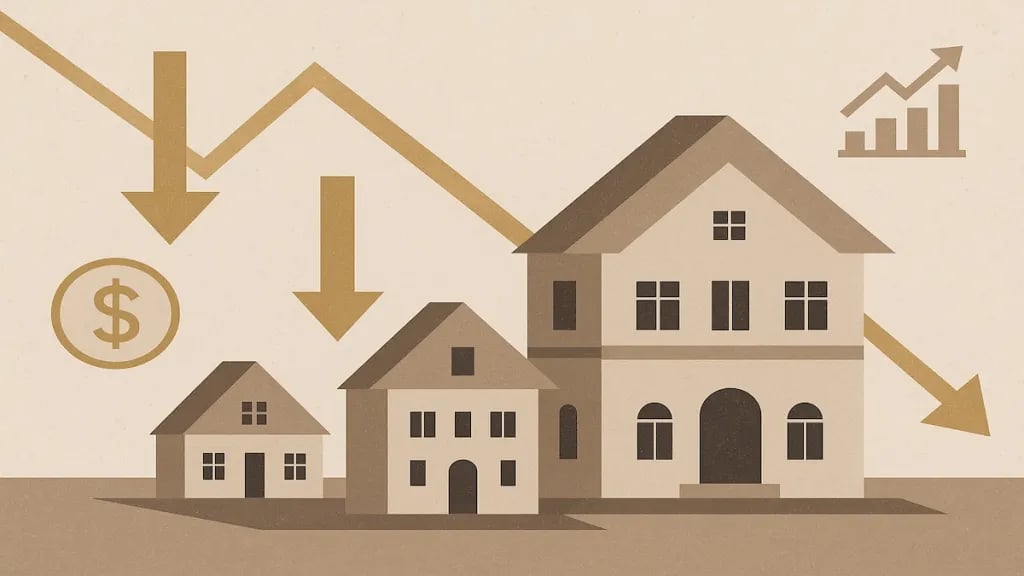
Demand Depth: The Hidden Shield Against Price Drops
Why a strong and diverse buyer pool protects property value
When the market cools or prices begin to dip, some neighborhoods resist declines better than others.
The secret behind this resilience isn’t luck or timing — it’s demand depth.
Let’s explore what it is, why it matters, and how smart buyers can use it to make better decisions.
1. What Is Demand Depth?
Demand depth refers to the strength and diversity of buyers interested in a community.
A neighborhood with deep demand has:
-
Multiple types of buyers (families, professionals, retirees)
-
Stable long-term interest in living there
-
Consistent demand across price ranges
Shallow demand, in contrast, relies on:
-
Speculators or investors
-
Short-term buyers
-
Narrow demographic groups
When demand is shallow, even a small market shift can trigger price drops.
2. How Demand Depth Protects Property Value
Strong demand acts like a buffer:
-
More buyers mean fewer price swings
-
Homes sell more consistently, even in downturns
-
Competitive interest keeps prices stable
Simply put: when many people want to buy, prices have a floor.
Neighborhoods with shallow demand can see sharp drops because only a few buyers drive the market, and they can step back quickly during uncertainty.
3. Indicators of Deep Demand
Smart buyers look beyond surface-level trends. Signs of demand depth include:
-
Diverse buyer profiles: Families, professionals, retirees, investors
-
Steady turnover: Homes sell regularly, but not excessively
-
Low vacancy rates: Rentals and homes remain occupied
-
Stable appreciation history: Prices rise steadily rather than spiking wildly
-
Strong local economy: Employment and population growth support housing needs
These signals suggest a community can withstand market fluctuations.
4. Demand Depth vs. Market Hype
Many buyers chase “hot” markets with rapid price gains.
But hype-driven growth is often shallow:
-
Mostly investors or flippers
-
Buyers reacting to momentum rather than lifestyle
-
High sensitivity to interest rate changes or short-term economic shifts
When momentum fades, these markets can experience steep declines.
Demand depth, on the other hand, is structural. It’s not dependent on emotion or trends.
5. How to Apply This Insight as a Buyer
When evaluating a neighborhood, ask:
-
Who is buying here?
-
Is the buyer pool diverse and sustainable?
-
How has the area performed during past slowdowns?
-
Are there strong lifestyle and economic fundamentals attracting long-term residents?
Prioritizing demand depth helps buyers choose properties more likely to retain value — even if the market softens.
Final Thoughts
Price drops are inevitable in real estate cycles. But not all areas experience the same level of decline.
Neighborhoods with deep, diverse demand act as a hidden shield:
-
They reduce volatility
-
Support quicker recovery
-
Preserve long-term value
In short: when everyone else focuses on flashy price trends, smart buyers focus on who is actually buying.
Because in real estate, the depth of demand often matters more than the height of price spikes.
--
Tina Jingru Sui 隋静儒
Associate Broker | Team Leader of TJS Team, Keller Williams
 Serving Metro Atlanta — Johns Creek, Alpharetta, Duluth, Suwanee, Buford, and beyond
 404-375-2120


 WeChat: tinasuirealty
 Follow me on Instagram / 小红书 / WeChat / Facebook