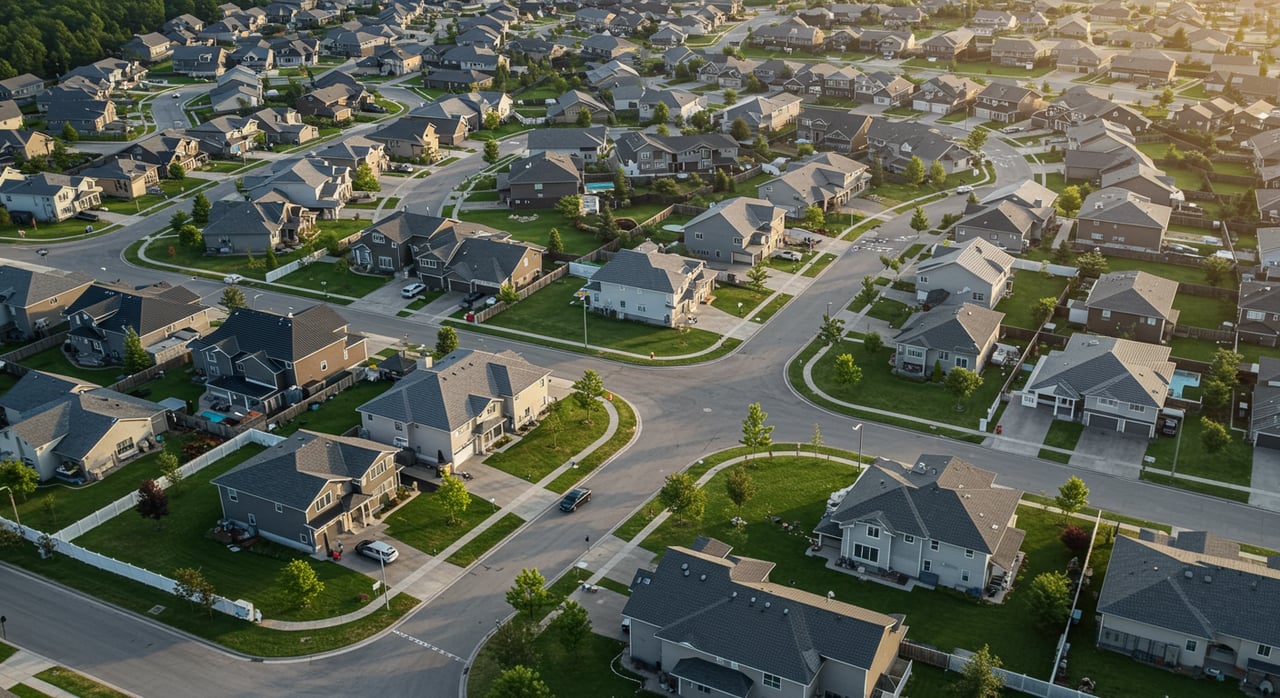
Your home does not exist in a vacuum. Changes to nearby businesses, roads, parks, housing inventory, development, traffic, infrastructure, and property conditions can influence how future buyers compare your home with other options. But neighborhood change does not create a guaranteed increase—or decrease—in property value. The important question is how those changes affect buyer demand, convenience, competition, and the property's overall market position.
What Happens to Your Home’s Value When the Neighborhood Changes?
Learn how new businesses, development, infrastructure, vacant properties, transportation, and changing buyer demand can influence a home’s marketability and value over time.
When people think about what makes a home valuable, they usually start with the property itself.
They look at:
- Square footage.
- Bedrooms and bathrooms.
- Condition.
- Renovations.
- Lot.
- Floor plan.
- Major systems.
But real estate is also tied to location.
If the area around a property changes, the way buyers evaluate that property may change too.
Don't ask only:
“Is this a good house today?”
Also ask: “What is happening around this property, and how could those changes affect future buyer demand?”
Neighborhood Change Can Affect Value in Different Ways
Change | Possible Effect |
|---|---|
New Retail & Restaurants | May improve convenience and change buyer interest in the location |
New Housing | May bring investment and amenities but can also increase supply or traffic |
Road / Infrastructure Improvements | May improve access while potentially changing traffic patterns |
Parks / Public Improvements | May improve access to amenities and public spaces |
Increasing Vacancy / Deferred Maintenance | May affect buyer perception and nearby comparable sales |
Commercial Redevelopment | Can change convenience, traffic, noise, views, and nearby land use |
1. New Businesses Can Change How Convenient a Location Feels
New grocery stores, restaurants, coffee shops, retail, medical services, and other businesses may change how buyers experience a location.
Buyers may value easier access to places they use frequently.
But not every commercial development has the same effect.
A new development may also affect:
- Traffic.
- Noise.
- Lighting.
- Parking patterns.
- Views.
- Road access.
“New development” is not automatically positive or negative.
What matters is what is being built, where it is located, and how it changes the property's actual surroundings.
2. Parks, Sidewalks, Roads, and Public Improvements Can Matter
Infrastructure can affect how convenient and usable an area feels.
Changes might include:
- New sidewalks.
- Road improvements.
- Intersection improvements.
- Parks and trails.
- Public-space improvements.
- Transit access.
These improvements may influence buyer demand by changing accessibility or convenience.
But buyers should evaluate the actual project rather than assuming every infrastructure project automatically increases nearby property values.
What About Schools?
Buyers may consider public-school attendance assignments as one of many property-specific factors.
If school assignment matters to your purchase decision, verify the exact property address directly with the applicable school district because boundaries and assignments can change.
Avoid assuming a future school assignment, school opening, rezoning, or boundary change unless it has been officially confirmed.
3. New Construction Can Help—or Create New Competition
New residential construction can change an area's housing market in several ways.
It may bring:
- New housing inventory.
- New retail or amenities.
- Road or infrastructure improvements.
- Changes in nearby land use.
But sellers should also think about competition.
If a large new-construction community opens nearby, resale homes may be competing with brand-new inventory.
New construction may offer buyers:
- New finishes.
- Builder warranties.
- Different financing incentives.
- Different floor plans.
Resale homes may compete through:
- Established lots.
- Existing landscaping.
- Different locations.
- Larger lots in some cases.
- Price or features.
Development can improve an area while simultaneously creating more competition for an individual seller.
4. Transportation Improvements Can Change Buyer Behavior
Changes to roads, intersections, transit, or highway access can alter how convenient a property feels.
But transportation projects can create trade-offs.
Potential Benefit | Potential Trade-Off |
|---|---|
Easier access | More traffic near certain properties |
Potentially shorter travel routes | Construction disruption |
Additional transportation options | Changes in nearby noise or activity |
The exact property's relationship to the project matters more than a broad statement that “new infrastructure is coming.”
5. Some Changes Can Reduce Buyer Appeal
Not every neighborhood trend increases demand.
Objective changes that may deserve closer attention include:
- Increasing numbers of visibly vacant properties.
- Significant deferred exterior maintenance.
- Closure of frequently used nearby businesses.
- Increasing traffic congestion.
- Persistent commercial vacancy.
- Infrastructure deterioration.
These conditions do not create a guaranteed future price outcome.
But they can affect how buyers compare the area with competing locations.
Value is influenced by more than what changes.
It also depends on how buyers respond to that change.
6. Neighborhood Change Can Eventually Show Up in the Comps
One of the clearest ways market change becomes visible is through actual transactions.
Watch:
- Recent sale prices.
- Days on market.
- Price reductions.
- Sale-to-list relationships.
- Active inventory.
- New-construction competition.
If multiple relevant homes begin selling differently from prior periods, that may provide stronger evidence of a market shift than simply noticing one new restaurant or one vacant storefront.
Look for patterns—not isolated events.
7. “Coming Soon” Is Not the Same as “Being Built”
Buyers often hear statements such as:
“A huge mixed-use development is coming nearby.”
Before using that information to justify a purchase decision, find out where the project actually stands.
Stage | What It Tells You |
|---|---|
Proposed | An idea or application exists; details may change substantially |
Approved | Some approvals may exist, but construction and timing are not guaranteed |
Funded / Permitted | The project may be further along, depending on its specific requirements |
Under Construction | Physical work has started, although timing and details can still change |
Completed | The actual impact can begin to be evaluated rather than projected |
Never pay a premium today solely because someone promises what the neighborhood will become tomorrow.
8. Think Ahead—but Don't Pretend You Can Predict 10 Years Perfectly
It is reasonable to consider where an area may be heading.
But predicting future home values with certainty is impossible.
Instead of asking:
“Will this neighborhood appreciate?”
ask more useful questions:
☐ What projects are actually proposed or approved?
☐ Is new housing supply increasing significantly?
☐ Are relevant recent homes selling differently than before?
☐ Are businesses opening, closing, or relocating?
☐ What transportation or infrastructure projects are documented?
☐ How would those changes affect this exact property?
☐ Would I still be comfortable owning the home if appreciation were slower than expected?
9. A Changing Neighborhood Does Not Make the House Itself Irrelevant
Location matters, but buyers still compare individual homes.
Two properties on the same street may perform differently because of:
- Condition.
- Lot position.
- Floor plan.
- Renovation level.
- Maintenance.
- Traffic exposure.
- Privacy.
- Pricing.
Home value is not simply:
House OR Neighborhood
It is the interaction between:
Property + Location + Condition + Competition + Buyer Demand
Before Buying, Research More Than the Listing
☐ Review recent comparable sales
☐ Review current competing listings
☐ Drive or walk the immediate area
☐ Look at nearby construction and vacant parcels
☐ Review planning and zoning information when relevant
☐ Research documented transportation projects
☐ Observe traffic and parking at relevant times
☐ Understand nearby new-construction competition
☐ Separate proposed projects from projects actually underway
☐ Decide whether the home makes sense based on today's facts—not only future hopes
Frequently Asked Questions
Does a new grocery store or restaurant increase nearby home values?
Not automatically. New businesses can improve convenience and may affect buyer demand, but the impact depends on location, traffic, noise, access, surrounding development, housing supply, and broader market conditions.
Does new construction increase the value of existing homes?
It can affect an area in several ways. New construction may bring investment and amenities, but it may also create additional housing competition. The impact on an individual resale property depends on the type, price, location, incentives, and buyer alternatives.
Should I buy near a proposed development?
Evaluate the development's actual status and how it could affect the specific property. Proposed projects may change or never be completed. Avoid basing your purchase price primarily on expected future development.
What signs suggest an area is changing?
Objective indicators may include new construction, business openings or closures, changing vacancy, infrastructure projects, rezoning activity, housing inventory, price trends, days on market, and changing nearby sale patterns. No single indicator proves what will happen next.
Can a great house overcome a weaker location?
A well-maintained or highly upgraded home may still attract buyers, but external location factors can affect the buyer pool and what purchasers are willing to pay compared with alternative properties.
Can anyone predict which neighborhood will appreciate the most?
No. Future property appreciation cannot be guaranteed. Buyers can study current market evidence, supply, development, infrastructure, property characteristics, and demand, but future economic and housing-market conditions remain uncertain.
When evaluating neighborhood change, ask:
What Is Changing + How Certain Is It + How Does It Affect This Property + How Are Buyers Responding?
Final Thoughts
Neighborhood change can absolutely influence how buyers evaluate a home.
But change should not automatically be labeled positive or negative.
Look at:
Businesses + Development + Infrastructure + Housing Supply + Property Conditions + Comps + Buyer Demand
Most importantly, separate real evidence from speculation.
A proposed development is not the same as a completed development.
A new business does not automatically increase home values.
A few vacant properties do not automatically prove an area is declining.
Look for multiple objective signals and evaluate how they relate to the specific property.
Your home's future value will never depend on just one restaurant, road project, development, or neighboring property.
The bigger picture is how the property and its surroundings continue to compete for buyer demand over time.
Wondering How Changes Around a Metro Atlanta Property Could Affect It?
Whether you're buying or selling, we can help you review recent comparable sales, active competition, nearby development, new-construction supply, listing trends, property condition, traffic and access, and other objective location factors so you can evaluate the home based on today's market evidence—not just assumptions about the future.
Tina Jingru Sui | TJS Team
Search Metro Atlanta Homes at TinaSui.com →
About Tina Jingru Sui
Tina Jingru Sui is the founder and leader of the TJS Team, serving buyers, sellers, investors, and relocation clients throughout Metro Atlanta.
Tina and her team serve communities including Johns Creek, Alpharetta, Suwanee, Duluth, Buford, Dacula, Marietta, Roswell, Sandy Springs, Smyrna, Lawrenceville, and surrounding Metro Atlanta areas.
Keller Williams Atlanta Partners · (404) 375-2120
This article is provided for general informational and educational purposes only and does not constitute legal, appraisal, investment, financial, zoning, land-use, school-assignment, engineering, tax, or other professional advice. Neighborhood changes, business openings or closures, infrastructure improvements, transportation projects, new construction, public improvements, vacancy, surrounding property conditions, and development activity do not guarantee an increase or decrease in property value. Proposed, approved, funded, permitted, or under-construction projects may change, be delayed, or never be completed as originally described. Future appreciation, buyer demand, resale value, and market conditions cannot be guaranteed. Public-school attendance assignments should be verified by exact property address with the applicable school district. Buyers and sellers should independently verify material information through appropriate government records, market data, due diligence, and qualified professionals when necessary. Evaluation of neighborhoods should rely on objective property, market, infrastructure, and location information and not assumptions concerning race, color, religion, sex, disability, familial status, national origin, or other legally protected characteristics. Equal Housing Opportunity. Tina Jingru Sui, GA License #392936, REALTOR®, affiliated with Keller Williams Atlanta Partners and regulated by the Georgia Real Estate Commission.