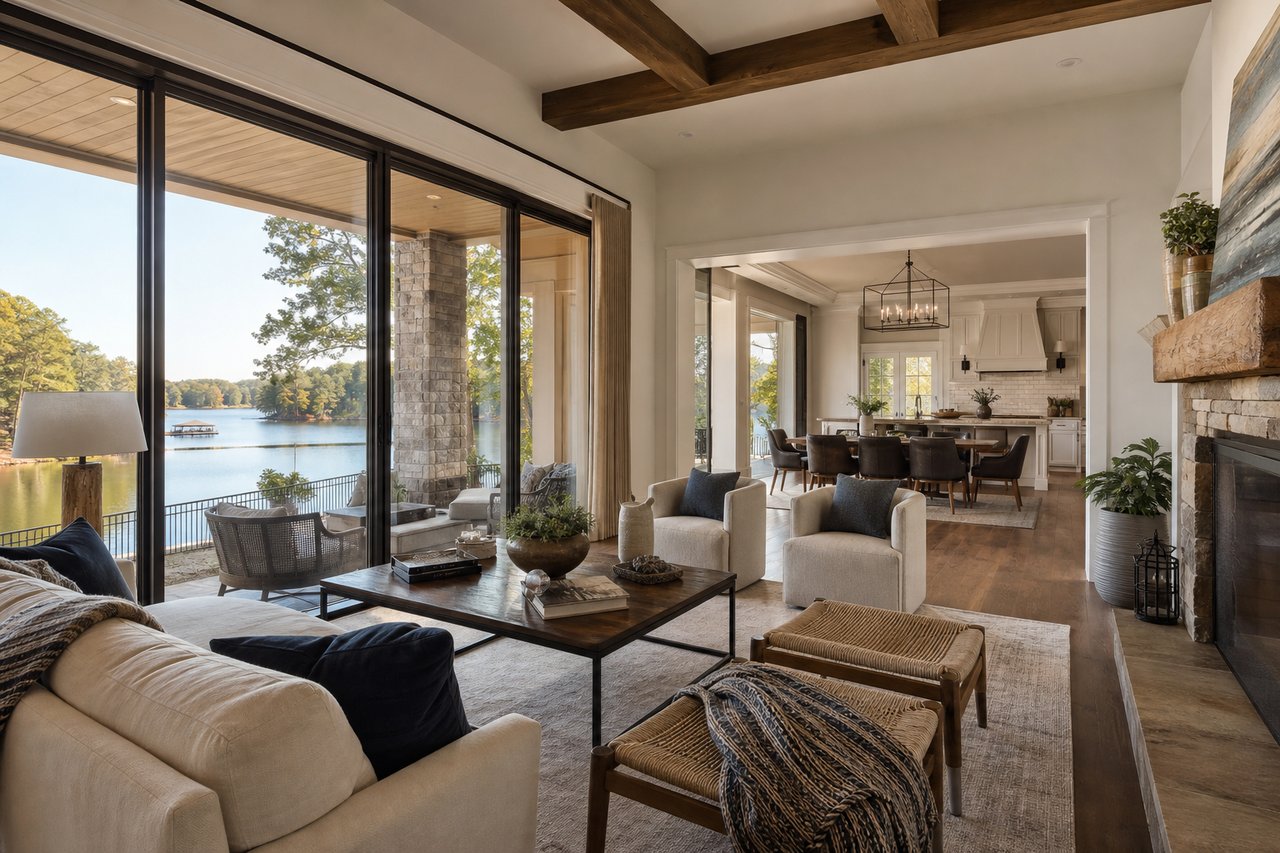
On Lake Lanier, you are not simply buying a house near water. You may also be paying for a permitted dock opportunity, water access, view corridor, shoreline position, lot quality, privacy, proximity to open water, and a waterfront configuration that cannot simply be recreated somewhere else. That is why two homes with similar square footage can have dramatically different values.
Why Is Lake Lanier Waterfront Real Estate So Expensive and Competitive?
The house is only one layer of the value. On Lake Lanier, the water, dock, lot, view, access, and shoreline rights can matter just as much.
Lake Lanier buyers often have the same reaction when they begin looking seriously:
“Why does this house cost so much more than another home only a few miles away?”
The answer is usually not just square footage.
Lakefront real estate operates differently from a conventional suburban neighborhood because the property is being valued on several layers at once.
The home matters.
But so do:
- Dock configuration.
- Permit status.
- Water access.
- Water depth and lake-level sensitivity.
- View.
- Lot topography.
- Walk to the shoreline.
- Cove versus more open-water positioning.
- Home condition and renovations.
- Location around the lake.
Lake Lanier Value
Is Not Just
House + Square Footage.
It Is
House + Lot + Water + Dock + Access + View + Scarcity.
What the Latest Full-Year Lake Lanier Market Data Shows
The most recent full-year annual Lake Lanier market report available in 2026 covers sales from 2025.
According to the report, Lake Lanier posted:
2025 Metric | Reported Result |
|---|---|
Average Sale Price | $1,276,242 |
Year-over-Year Change | +10% |
Reported Closed Sales | 312 |
Average Days on Market | 89 days, versus 69 the prior year |
Reported Sale-to-List Ratio | 95% |
Average Price per Sq. Ft. | $342, versus $330 the prior year |
$1 Million+ Sales | 163, up 9% |
Source: March 29, 2026 Lake Lanier annual market review published by Lakeside News / Sheila Davis Group using FMLS market data. These figures are a market report snapshot and should not be treated as an appraisal or as a substitute for property-specific comparable sales.
The market is more measured—but premium lake property has not disappeared
The increase from 69 to 89 average days on market matters.
Buyers generally have more time to evaluate properties than they did during the most aggressive pandemic-era market.
But the combination of a higher reported average sale price and a 95% sale-to-list ratio also shows why Lake Lanier should not simply be described as “cheap because homes are sitting longer.”
The better conclusion is:
Lake Lanier has become more property-specific.
Pricing, dock quality, lot, view, condition, and water access matter more when buyers have enough inventory and time to compare.
The Lake Lanier Waterfront Value Stack
I would not evaluate a Lake Lanier home using one broad “waterfront premium.”
Instead, break the property into six value layers.
Layer | What to Evaluate |
|---|---|
1. Dock | Permit status, configuration, condition, access, size and usefulness |
2. Water | Water depth, cove position, lake-level sensitivity, boating access |
3. View | Open-water view, seasonal view, tree coverage, view corridor |
4. Lot | Slope, usable land, privacy, walk to dock, driveway, topography |
5. House | Condition, layout, renovations, age, usable square footage, outdoor living |
6. Location Around the Lake | Road access, commute, nearby amenities, marina access and daily convenience |
1. A Private Dock Is Not Just Another Amenity
On many suburban homes, you can add a deck later.
You may be able to add a pool later.
You can renovate a kitchen later.
A Lake Lanier dock situation is different because the shoreline is managed by the U.S. Army Corps of Engineers.
The Corps manages permits for facilities and work on public land surrounding the lake, including docks.
More importantly, the Corps states that the number of permits that may be issued on the lake is limited.
A Renovated Kitchen
Can Be Recreated.
A Permittable Lake Position May Not Be.
But buyers need to understand what a dock permit actually is
This is one of the most important Lake Lanier due-diligence points.
According to the U.S. Army Corps of Engineers' Lake Lanier permit guidance:
- Permits and licenses may be issued for a maximum period of five years.
- They are nontransferable.
- They do not convey private real-estate rights on government property.
- New owners of property associated with existing facilities may apply for the applicable permit.
- Modification of permitted facilities requires prior approval.
In other words:
Do not treat “house has a dock” as the end of your dock due diligence.
Verify the facility, current documentation, applicable permit process and any planned modifications directly with the appropriate Corps office and relevant professionals.
2. How Much Is a Private Dock Worth? There Is No Universal Number
You may see market reports showing private-dock homes selling for higher average prices.
For example, a 2024 Lakeside News article reviewing 2023 transactions reported:
- Average sale price of private-dock homes: $1,225,597
- Average sale price of all lake homes in the report, including marina-slip properties: $1,113,443
The difference is more than $112,000.
But it would be incorrect to say:
“Therefore, the dock itself was worth exactly $112,000.”
Those two groups can also differ in:
- House size.
- Home condition.
- Lot quality.
- Water depth.
- View.
- Location.
- Construction quality.
The following year's data reinforces why a fixed dock adjustment is dangerous: the 2024 report showed an average of approximately $1.159 million for homes with either private docks or boat slips, while private-dock homes alone averaged approximately $1.155 million.
Dock Configuration
Is a Major Pricing Variable.
But:
Dock Premium ≠ One Fixed Dollar Amount
3. Not All Dock Access Gives You the Same Water
Two houses can both advertise a private dock and still provide very different lake experiences.
Buyers may want to evaluate:
- Water depth around the dock.
- How the location responds to changing lake levels.
- Cove depth.
- Proximity to more open water.
- Boat maneuverability.
- Dock access at different lake conditions.
The phrase “deep water” should not simply be accepted as a marketing label.
If water access is a major reason you are buying the property, investigate it carefully and understand that Lake Lanier water levels fluctuate.
4. View Can Matter Almost as Much as the Dock
There is a major difference between:
- A narrow cove view.
- A seasonal water view.
- A broad open-water view.
- A view blocked heavily by vegetation.
View quality can affect both enjoyment and how buyers compare competing lake properties.
But evaluate what creates the view.
Tree removal, trimming, vegetation management and work on public land may be subject to Corps rules and approvals.
Don't buy a lake view assuming you can simply cut whatever stands between the house and the water.
5. The Walk to the Dock Is Part of the Property
This is a feature that photographs poorly but matters enormously in person.
Imagine two homes with similar docks.
Property A has a relatively manageable path to the shoreline.
Property B requires a long, steep walk.
Those can create very different ownership experiences.
Consider:
- Slope.
- Distance.
- Steps.
- Path condition.
- Carrying coolers or boating supplies.
- Your expected ownership period.
Don't Evaluate Only
the Dock.
Evaluate the Journey to the Dock.
6. Lake Lots Can Be More Important Than Buyers Expect
Two lake homes with the same interior square footage may sit on completely different pieces of land.
Compare:
- Usable backyard.
- Slope.
- Drainage.
- Privacy.
- Driveway.
- Tree coverage.
- Outdoor living areas.
- Relationship between house and shoreline.
On lake property, the best lot is not necessarily the largest lot.
A smaller lot with a better view, easier dock walk and stronger water access may provide more practical waterfront value than a larger but difficult lot.
7. “Waterfront” Does Not Mean You Privately Own Everything to the Waterline
Lake Lanier is different from many privately owned waterfront environments.
The Corps manages public land around the lake and specifically states that shoreline permits do not convey private real-estate rights or private exclusive-use privileges over government property.
That distinction matters.
Buyers should understand:
- Where the private property boundary is.
- Where Corps-managed land begins.
- What facilities are permitted.
- What vegetation or shoreline work requires approval.
On Lake Lanier, “my backyard reaches the lake” and “I privately own all the land to the water” are not automatically the same statement.
8. The House Still Matters—A Lot
Waterfront scarcity does not mean buyers will ignore the house.
Compare:
- Age and condition.
- Floor plan.
- Natural light.
- Indoor-outdoor connection.
- Primary suite.
- Kitchen functionality.
- Basement quality.
- Outdoor living.
- Major systems.
A superior dock does not automatically erase a poorly functioning home.
And a beautifully renovated house does not automatically erase weak water access.
On Lake Lanier:
The House and the Waterfront Have to Be Valued Together.
9. Renovation Can Improve the House—but It Cannot Fix Every Waterfront Weakness
Suppose you find a dated lake home.
You can potentially improve:
- Kitchen.
- Bathrooms.
- Flooring.
- Lighting.
- Interior finishes.
But you may not be able to change:
- Cove position.
- Water depth.
- Lot slope.
- Distance to the dock.
- View orientation.
That means a dated home on a fundamentally strong waterfront lot may deserve very different analysis from a beautifully renovated home with compromised water access.
On waterfront property, buy very carefully when the weakness is something renovation cannot solve.
10. Private Dock vs. Marina Slip: Different Products, Not Simply Better vs. Worse
A private dock can be a major lifestyle advantage.
But a home with marina or community slip access may offer a different combination of price, convenience and maintenance responsibilities.
A buyer should compare:
Private Dock Property | Community / Marina Slip Property |
|---|---|
Immediate access from the home | May require travel or walking to shared dock location |
More direct dock responsibility | Responsibilities depend on marina/community arrangement |
Scarce property configuration | Can create a lower entry point in some situations |
Highly property-specific water access | Slip terms, availability and rules must be verified |
One is not automatically the right answer for every buyer.
11. Where You Are on the Lake Still Matters
Lake Lanier is a large market.
Buyers may look around Gainesville, Cumming, Buford, Flowery Branch, Dawsonville and other lake-access areas, but the daily experience can vary significantly depending on the exact property.
Compare:
- Commute to work.
- Access to major roads.
- Grocery and restaurant convenience.
- Distance to healthcare.
- Marinas and boating destinations.
- How often you will actually drive into Metro Atlanta.
The lake lifestyle may be the same conceptually.
The commute can be completely different.
12. Be Careful Using Price per Square Foot Alone
The 2025 annual report cited an average of $342 per square foot.
That number is useful for broad context.
But Lake Lanier is exactly the kind of market where price per square foot can become misleading when used by itself.
Imagine two 4,000-square-foot homes.
One has:
- A strong permitted dock configuration.
- Better water access.
- Open-water views.
- An easy dock walk.
The other does not.
Dividing both sale prices by interior square footage does not fully capture those differences.
On Lake Lanier,
Price per Sq. Ft.
Is Context.
It Is Not the Whole Valuation.
13. Good Lake Comps Need to Compare the Waterfront Too
When evaluating a conventional suburban home, buyers often compare:
- Subdivision.
- Square footage.
- Bedrooms.
- Bathrooms.
- Condition.
On Lake Lanier, I would add:
- Private dock vs. community slip.
- Dock configuration.
- Water depth.
- Cove / water position.
- View quality.
- Lot slope.
- Walk to water.
A lake comp is not truly comparable just because the houses are similar.
The waterfront needs to be reasonably comparable too.
14. Is Lake Lanier Still Competitive in 2026?
The answer is more nuanced than simply “yes” or “no.”
The 2025 annual report showed average days on market increasing to 89 days.
That suggests buyers have more time than they did during the fastest pandemic-era conditions.
But not every listing behaves like the average.
A property with:
- Strong water access.
- Desirable dock setup.
- Good lot.
- Strong views.
- Updated or well-maintained house.
- Defensible pricing.
can compete differently from a property with compromises in several of those categories.
Therefore:
Lake Lanier Is Not
One Market.
It Is
Many Micro-Markets Connected by the Same Lake.
15. Longer Days on Market Can Create Negotiation Opportunity—but Diagnose Why
A lake home that has been on the market for 100 days may create an opportunity.
But before assuming the seller will accept a large discount, ask:
“Why has this particular property been sitting?”
Possible reasons might include:
- Price.
- Condition.
- Dock limitations.
- Water access.
- Lot slope.
- Location.
- Highly specialized design.
The best negotiation strategy depends on diagnosing the actual source of buyer resistance.
The Lake Lanier Buyer Test: 25 Questions Before Making an Offer
☐ 1. Is this property truly waterfront, and where is the private property boundary?
☐ 2. Is there a private dock, community slip, marina access, or no dock access?
☐ 3. What documentation exists for the current dock facility?
☐ 4. What must a new owner do with the Corps regarding the existing facility?
☐ 5. Are any planned dock modifications subject to approval?
☐ 6. What is the condition of the dock?
☐ 7. What is the water depth around the dock?
☐ 8. How sensitive is access to changing lake levels?
☐ 9. Is the property in a narrow cove or closer to open water?
☐ 10. How easy is it to maneuver a boat in and out?
☐ 11. What is the view from the main living areas?
☐ 12. Is the view seasonal or year-round?
☐ 13. What is the slope from the home to the water?
☐ 14. How long is the walk to the dock?
☐ 15. Is the yard actually usable?
☐ 16. What work on shoreline or Corps property requires approval?
☐ 17. What did the home inspection reveal?
☐ 18. What major systems may create future expense?
☐ 19. Is the floor plan strong enough apart from the waterfront?
☐ 20. How does the location work for my normal commute and routine?
☐ 21. Which relevant sales had similar dock and water characteristics?
☐ 22. Am I comparing this property mainly by price per square foot when I should not be?
☐ 23. What permanent waterfront weakness would I have to explain to a future buyer?
☐ 24. Does the current price reflect that trade-off?
☐ 25. Am I buying the house—or am I paying primarily for the waterfront? And am I comfortable with that answer?
The 100-Point Lake Lanier Waterfront Scorecard
Category | Weight | What to Evaluate |
|---|---|---|
Dock & Permit Situation | 20 | Documentation, configuration, condition, usefulness and new-owner process |
Water Access | 15 | Depth, cove, boating access, lake-level sensitivity |
View | 10 | Quality, permanence, seasonality and visibility from main rooms |
Lot & Dock Walk | 15 | Slope, usable land, privacy, path and topography |
House Condition & Layout | 15 | Function, renovations, inspection, systems and indoor-outdoor living |
Location & Daily Convenience | 10 | Commute, major roads, recurring destinations and lake access |
Price vs. Comparable Evidence | 15 | Comparable lake homes with similar waterfront characteristics |
Total | 100 | Use the score to expose differences—not to replace professional due diligence. |
Selling a Lake Lanier Home? Market the Waterfront Like an Asset
Sellers should not assume buyers will automatically understand why one lake property deserves a premium.
If relevant and properly documented, marketing may need to clearly explain:
- Dock configuration.
- Available permit documentation.
- Water access.
- View.
- Dock walk.
- Outdoor living areas.
- Lot characteristics.
- Renovations and maintenance.
But pricing still needs to be anchored in relevant evidence.
“Waterfront” is not a complete pricing strategy.
Buyers will compare the quality of the waterfront.
Frequently Asked Questions About Lake Lanier Waterfront Homes
What is the average price of a Lake Lanier home?
The latest full-year annual Lake Lanier report published in March 2026 reported a 2025 average sale price of $1,276,242. That number is useful for market context but should not be treated as the value of a particular home because waterfront configuration varies significantly.
Are Lake Lanier home prices still rising?
The March 2026 annual report stated that the 2025 average sale price increased 10% from the prior year. That describes the reported historical market data and does not guarantee future appreciation.
How many $1 million-plus Lake Lanier homes sold in 2025?
The annual report stated that 163 homes at $1 million or above sold in 2025, representing a 9% increase from the prior year.
How much does a private dock add to the value?
There is no universal fixed dock premium. Historical market reports have shown different average pricing patterns across private-dock and broader lake-home samples, but those groups also differ in home size, condition, lot, water access, view and other characteristics. The appropriate analysis is property-specific.
Does a dock permit automatically transfer when I buy the house?
U.S. Army Corps of Engineers guidance states that shoreline permits and licenses are nontransferable. New owners associated with existing facilities may apply for the appropriate permit. Buyers should verify the current process, documents and facility status directly with the Corps and appropriate transaction professionals.
Does owning a lakefront house mean I own the shoreline?
Not necessarily. The Corps manages public land around Lake Lanier, and shoreline-use permits do not convey private real-estate rights or exclusive ownership privileges over government property. Property boundaries should be independently verified when material.
Is a deep-water dock always more valuable?
Water depth and dependable boating access can be meaningful property characteristics, but no universal value adjustment applies. Buyers should verify actual conditions and compare similar lake properties rather than relying on the marketing label alone.
Is an open-water view worth more?
Views can influence buyer demand and property comparisons, but there is no fixed universal view premium. The quality, permanence, orientation, lot, home condition and overall waterfront package all matter.
Are buyers able to negotiate on Lake Lanier in 2026?
The latest full-year report showed average days on market increasing to 89 days in 2025, which can give buyers more time on some listings than during the pandemic-era market. Negotiating leverage remains property-specific and depends on pricing, competition, condition, dock situation and seller circumstances.
Is price per square foot useful for Lake Lanier homes?
It is useful as one reference point but should not be the only valuation tool. Square footage does not capture dock configuration, water depth, view, lot slope, shoreline access and other waterfront characteristics.
What should I verify before buying a Lake Lanier waterfront property?
Depending on the property and your intended use, consider verifying property boundaries, dock and permit information, shoreline-use restrictions, water access, dock condition, lot topography, home condition, HOA rules where applicable, title matters and relevant comparable sales. Appropriate attorneys, inspectors, surveyors, contractors, Corps personnel and other professionals should be involved when their expertise is needed.
The Most Important Question
Is Not:
“How Much Is This Lake House per Square Foot?”
It Is:
“What Exactly Am I Buying on the Water?”
Final Thoughts: On Lake Lanier, Value Lives Outside the Walls Too
Lake Lanier waterfront real estate is expensive because the best properties combine several scarce characteristics.
But that does not mean every waterfront house deserves the same premium.
Before buying or pricing one, evaluate:
Dock and permit situation.
Water access.
Water depth.
View.
Lot.
Dock walk.
Corps-managed shoreline.
Home condition.
Layout.
Location around the lake.
And truly comparable waterfront sales.
On Lake Lanier, the house is only part of the asset.
The real question is how well the house, land, water, dock and access work together—and whether the price reflects that exact combination.
Comparing Lake Lanier Waterfront Homes?
We can help structure the comparison beyond square footage and asking price—looking at relevant sales, dock configuration, waterfront position, lot, view, access, home condition, location and the trade-offs that make each Lake Lanier property different. For dock permits, shoreline rights, surveys, inspections and other specialized matters, we can also help coordinate the appropriate professionals and official sources so important facts are verified before you make a decision.
Tina Jingru Sui | TJS Team
Search Metro Atlanta Homes at TinaSui.com →
About Tina Jingru Sui
Tina Jingru Sui is the founder and leader of the TJS Team, serving buyers, sellers, investors, and relocation clients throughout Metro Atlanta.
Tina and her team serve communities including Atlanta, Johns Creek, Alpharetta, Suwanee, Duluth, Buford, Dacula, Marietta, Roswell, Sandy Springs, Smyrna, Lawrenceville, and surrounding Metro Atlanta areas.
Keller Williams Atlanta Partners · (404) 375-2120
This article is provided for general informational and educational purposes only and does not constitute legal, financial, tax, investment, lending, appraisal, survey, title, environmental, zoning, engineering, inspection, construction, boating, shoreline-management, insurance, permitting, or other professional advice. Market figures referenced in this article are based on published Lake Lanier market reports and are historical market snapshots, not guarantees of current or future value, appreciation, demand, days on market, sale price, or marketability. Market-report averages may include properties with materially different homes, lots, dock configurations, water access, views, conditions and locations and should not be used as a fixed adjustment for an individual property. A historical difference between average sale prices of private-dock homes and a broader lake-home sample does not establish that the dock alone caused the entire price difference or that a fixed private-dock premium applies to future transactions. The “Waterfront Value Stack” and 100-point scorecard are educational comparison frameworks only and are not appraisal methods. Lake Lanier shoreline and public lands are managed by the U.S. Army Corps of Engineers. Corps permit rules, availability, durations, ownership-change procedures, facility requirements and shoreline policies should be verified directly with the appropriate Corps office because requirements can change and are property-specific. Shoreline permits or licenses should not be treated as private ownership rights in government property. Buyers should independently verify property boundaries, surveys, easements, title matters, permitted facilities, dock condition, water depth, boating access, Corps boundaries, HOA restrictions, flood considerations and other material matters through appropriate official sources and qualified professionals. Water depth and lake access can change with lake levels and other conditions. References to “deep water,” “open water,” “year-round water,” or similar marketing terms should be independently verified when material. Property and system age alone does not establish condition, defect, remaining useful life, or replacement need. Renovation costs do not guarantee an equal increase in market value. A Comparative Market Analysis prepared by a real estate professional is not an appraisal and does not guarantee appraised value, purchase price, future sale price, appreciation, buyer demand, or net proceeds. There is no universal fixed adjustment for a dock, view, water depth, lot slope, shoreline position, marina slip, or other waterfront characteristic. A real estate professional can help buyers and sellers compare market evidence, property characteristics, current listings and transaction factors but does not replace attorneys, surveyors, Corps personnel, appraisers, inspectors, engineers, contractors, lenders, tax professionals, title professionals or insurance professionals. Community and location comparisons should rely on objective property and lifestyle criteria identified by the consumer and not on characteristics protected by Fair Housing law. Equal Housing Opportunity. Tina Jingru Sui, GA License #392936, REALTOR®, affiliated with Keller Williams Atlanta Partners and regulated by the Georgia Real Estate Commission.