A finished basement can add valuable flexibility to a home—but not all finished basements are equal. Before paying a premium, buyers should evaluate moisture history, drainage, permits, ceiling height, HVAC, electrical and plumbing work, emergency exits, finish quality, and how comparable homes in the area value below-grade space.
Should You Buy a Home With a Finished Basement?
Explore the benefits, costs, and potential drawbacks of buying a home with a finished basement.
A finished basement can make a home feel dramatically larger.
It can create space for a home office, media room, gym, guest area, playroom, hobby space, or additional storage.
But buyers should look beyond the flooring, paint, furniture, and staging.
Because a basement is below or partially below grade, issues involving moisture, drainage, ventilation, workmanship, and code compliance can matter more than they initially appear.
Don't evaluate a finished basement only by how it looks.
Evaluate how it was built, how dry it stays, how comfortable it is, and how useful the space really is.
Finished Basement: Benefits vs. Questions to Investigate
Potential Benefit | What Buyers Should Check |
|---|---|
More usable space | Ceiling height, layout, lighting, access, and comfort |
Additional rooms | Permits, intended use, windows, exits, and code requirements |
Entertainment or work space | HVAC performance, humidity, electrical capacity, and sound |
Potential resale appeal | How local buyers and comparable sales treat finished basement space |
Flexibility | Whether the space actually fits your long-term needs |
1. A Finished Basement Can Add Valuable Usable Space
One of the clearest advantages is flexibility.
Depending on the layout, a basement might work as:
- Family or media room.
- Home theater.
- Game room.
- Home office.
- Exercise area.
- Guest space.
- Hobby room.
- Storage.
That extra flexibility can allow a buyer to choose a smaller above-grade footprint while still getting the functional space they want.
The important question is not simply, “Is the basement finished?”
Ask, “Will I actually use this space enough to justify paying more for it?”
2. It Can Make the Home Much More Functional
A finished basement can reduce pressure on the main level.
Instead of using a bedroom as an office or filling the main living room with exercise equipment, the basement may provide separate zones for work, recreation, guests, or hobbies.
But functionality depends heavily on layout.
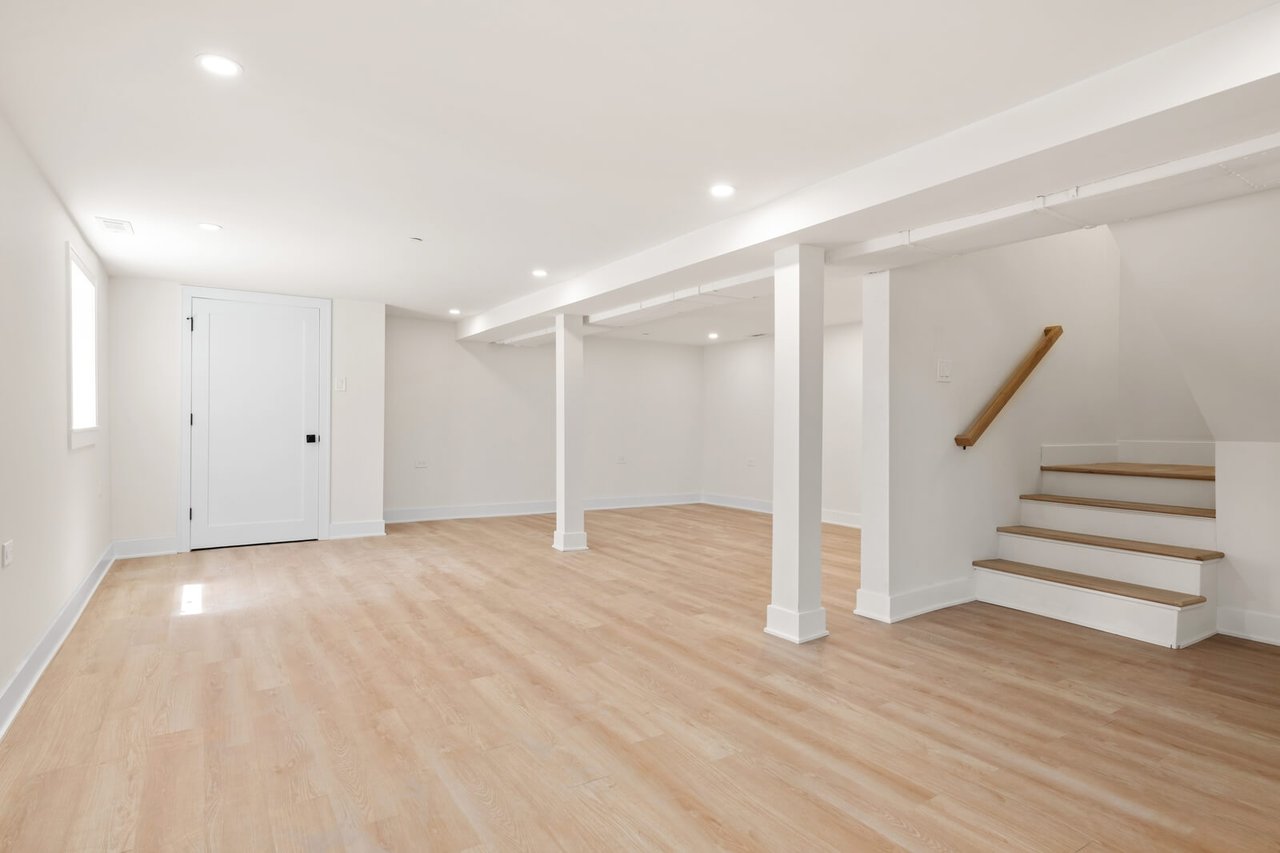
A large open basement with good ceiling height and natural light may be much more useful than the same amount of square footage divided into dark, awkward rooms.
3. Moisture Should Be One of Your First Concerns
Water management matters in any home, but it deserves special attention in below-grade areas.
During your inspection and walkthrough, pay attention to:
- Musty odors.
- Water stains.
- Discoloration.
- Damp walls or flooring.
- Peeling or bubbling paint.
- Warped flooring.
- Efflorescence on masonry.
- Visible growth that warrants further evaluation.
A stain does not automatically prove there is an active leak today.
Likewise, a freshly painted wall does not prove there has never been a moisture problem.
Visible symptoms can tell you where to investigate.
They do not always tell you the underlying cause.
4. Look Outside the Basement Too
Basement water problems often begin outside.
Review conditions such as:
- Gutters.
- Downspout extensions.
- Grading around the foundation.
- Drainage paths.
- Retaining walls.
- Sump pumps where installed.
- Exterior drainage systems.
Water should generally be directed away from the foundation rather than collecting against it.
If there is evidence of recurring water intrusion, a qualified specialist may be appropriate.
5. Ask Whether the Basement Work Was Permitted When Required
A basement can look professionally finished and still raise questions about how the work was completed.
Depending on the jurisdiction and scope of work, permits may have been required for items such as:
- New electrical circuits.
- Plumbing.
- Bathrooms.
- Structural changes.
- New walls or alterations.
- Certain mechanical work.
Requirements vary by local jurisdiction and by the type and timing of the work.
If permits matter to your decision, verify available records with the appropriate city or county authority rather than relying only on the seller's recollection.
“Finished” and “properly documented” are not necessarily the same thing.
6. Ceiling Height and Layout Can Matter More Than Square Footage
Two basements with the same finished area can feel completely different.
Pay attention to:
- Ceiling height.
- Soffits and ductwork.
- Natural light.
- Stair width and access.
- Room proportions.
- Window placement.
- How easily furniture fits.
A beautifully finished basement with low ceilings and limited natural light may not provide the same utility as a walk-out basement with large windows and good access.
7. Don't Assume Every Basement Room Is a Legal Bedroom
A room containing a bed, closet, and attractive finishes is not automatically a code-compliant bedroom.
Depending on the jurisdiction and circumstances, factors may include:
- Emergency escape and rescue openings.
- Window dimensions and location.
- Ceiling height.
- Smoke and carbon-monoxide detection.
- Other applicable building requirements.
Requirements vary by jurisdiction and can depend on when work was completed.
If the bedroom count or intended use is material to your purchase decision, verify the relevant records and requirements.
A room's furniture does not determine its legal classification.
8. Make Sure the Space Is Actually Comfortable
A finished basement is much less useful if it stays cold in winter, humid in summer, or noticeably different from the rest of the house.
Ask:
- How is the basement heated and cooled?
- Does the existing HVAC serve the basement?
- Is there a separate system or zone?
- How old is the equipment?
- Is humidity controlled?
An older HVAC system does not automatically mean it needs immediate replacement.
But its age, condition, maintenance history, and ability to comfortably serve the space should be part of your ownership-cost analysis.
9. Pay Attention to Electrical and Plumbing Work
Finished basements often involve significant work hidden behind drywall.
If the basement includes a bathroom, kitchenette, wet bar, entertainment equipment, or numerous new outlets and lighting circuits, the quality of the underlying work matters.
A general home inspection may identify visible concerns, but certain conditions may warrant evaluation by appropriately qualified specialists.
10. Don't Assume Every Finished Square Foot Has the Same Value
A finished basement can contribute meaningful market value.
But below-grade finished space is not necessarily treated the same as above-grade living area in appraisal, MLS reporting, or buyer comparisons.
Consider two homes:
Home A | Home B |
|---|---|
3,000 sq. ft. above grade | 4,000 sq. ft. above grade |
1,500 sq. ft. finished basement | 500 sq. ft. finished basement |
4,500 total finished sq. ft. | 4,500 total finished sq. ft. |
Both homes may have the same total finished area, but buyers and appraisers may not consider them economically identical.
Compare above-grade space with above-grade space—and basement space with relevant basement comparables.
Walk-Out vs. Interior-Entry Basement
Basement characteristics can also affect how buyers perceive the space.
A walk-out basement with exterior doors, windows, natural light, and convenient yard access may have different utility and market appeal than a basement accessed only from inside the home.
That does not mean one automatically receives a specific premium.
The local comparable sales should help tell that story.
11. Include Basement-Specific Maintenance in Your Budget
A finished basement may create additional ownership costs over time.
Potential expenses can include:
- Waterproofing.
- Drainage corrections.
- Sump-pump replacement or maintenance.
- Dehumidification.
- Flooring replacement.
- Drywall repairs after plumbing or water issues.
- HVAC maintenance.
- Plumbing repairs.
- Professional remediation if moisture-related problems develop.
These possibilities do not mean you should avoid buying a home with a basement.
They simply belong in the total-cost analysis.
Is a Finished Basement Worth Paying More For?
Possibly.
But the premium should make sense relative to the quality and usefulness of the space.
Evaluate:
☐ Finish quality
☐ Moisture history
☐ Permitting and documentation
☐ Natural light and ceiling height
☐ HVAC and comfort
☐ Functional layout
☐ How much you will personally use it
☐ How comparable homes with finished basements are selling
Don't pay a premium just because the basement is beautiful.
Pay attention to whether it is dry, functional, well-built, documented, and valuable in that specific market.
Finished Basement Buyer Checklist
☐ Is there any known history of water intrusion?
☐ Do I notice musty odors, stains, or moisture symptoms?
☐ How are gutters, downspouts, grading, and drainage functioning?
☐ Is there a sump pump or other drainage system?
☐ Were required permits obtained for the work?
☐ Do electrical and plumbing components appear properly completed?
☐ Is the ceiling height and layout comfortable?
☐ Does the basement have adequate natural light?
☐ Are intended sleeping rooms appropriately configured and documented?
☐ Is the HVAC adequate for the basement?
☐ What future basement-specific maintenance should I expect?
☐ How do comparable homes with similar basements sell in this neighborhood?
Frequently Asked Questions
Does a finished basement always add value?
A finished basement can contribute market value and buyer appeal, but the amount depends on the local market, finish quality, functionality, condition, access, ceiling height, natural light, documentation, and comparable sales. It should not be assumed to add a fixed dollar amount.
Is finished basement square footage worth the same as above-grade space?
Not necessarily. Below-grade finished space may be reported and analyzed separately from above-grade living area. Appraisal treatment and buyer behavior vary, so compare the property with appropriate local comparable sales rather than using one price-per-square-foot number for all finished space.
Can a basement bedroom be counted as a bedroom?
Do not assume so based only on furniture, a closet, or marketing language. Applicable building requirements and property records may matter, especially for emergency escape and rescue provisions. Verify material bedroom-count questions with the appropriate local authority and relevant professionals.
Should I avoid a basement if I see an old water stain?
Not automatically. An old stain may reflect a resolved issue, an active problem, or something unrelated. The useful next step is to investigate the source, history, repairs, drainage, and current condition rather than assuming either the best or worst.
Is a finished basement better than an unfinished basement?
It depends on your priorities. A finished basement offers immediate usable space, while an unfinished basement may offer storage, easier access to some building systems, and the ability to design the space later. Compare the price difference with how much value the finished space actually provides to you.
Final Thoughts
A finished basement can be one of the most useful features in a home.
It can create additional flexibility without requiring a larger above-grade footprint.
But buyers should look beyond the appearance of the space.
Evaluate:
Moisture + Drainage + Permits + Layout + Ceiling Height + HVAC + Electrical + Plumbing + Exits + Comparable Sales + Maintenance
Most importantly, determine whether the basement provides functionality that is genuinely valuable to you.
A finished basement can add convenience and value—but finish quality alone isn't enough.
The best basement is one that is functional, well-maintained, appropriately documented, and priced realistically compared with similar homes.
Comparing Homes With Finished Basements in Metro Atlanta?
We can help you compare specific properties using above-grade living area, basement finish quality, recent comparable sales, property condition, major-system age, inspection findings, lot characteristics, and future maintenance exposure so you can better understand whether the price difference makes sense.
Tina Jingru Sui | TJS Team
About Tina Jingru Sui
Tina Jingru Sui is the founder and leader of the TJS Team, serving buyers, sellers, investors, and relocation clients throughout Metro Atlanta.
Tina and her team serve communities including Johns Creek, Alpharetta, Suwanee, Duluth, Buford, Dacula, Marietta, Roswell, Sandy Springs, Smyrna, and surrounding Metro Atlanta areas.
Keller Williams Atlanta Partners · (404) 375-2120
This article is provided for general informational and educational purposes only and does not constitute legal, appraisal, inspection, engineering, building-code, environmental, investment, tax, or financial advice. Basement permitting, bedroom classification, emergency-egress requirements, square-footage reporting, building standards, and code requirements vary by jurisdiction and may depend on when work was completed. A general home inspection is limited in scope and cannot guarantee that concealed defects, moisture conditions, code issues, or future problems do not exist. Finished basement space may be treated differently from above-grade living area for appraisal, MLS reporting, and market comparison purposes. Buyers should independently verify material facts and consult appropriate inspectors, contractors, engineers, appraisers, local building officials, attorneys, or other qualified professionals when needed. Equal Housing Opportunity. Tina Jingru Sui, GA License #392936, REALTOR®, affiliated with Keller Williams Atlanta Partners and regulated by the Georgia Real Estate Commission.