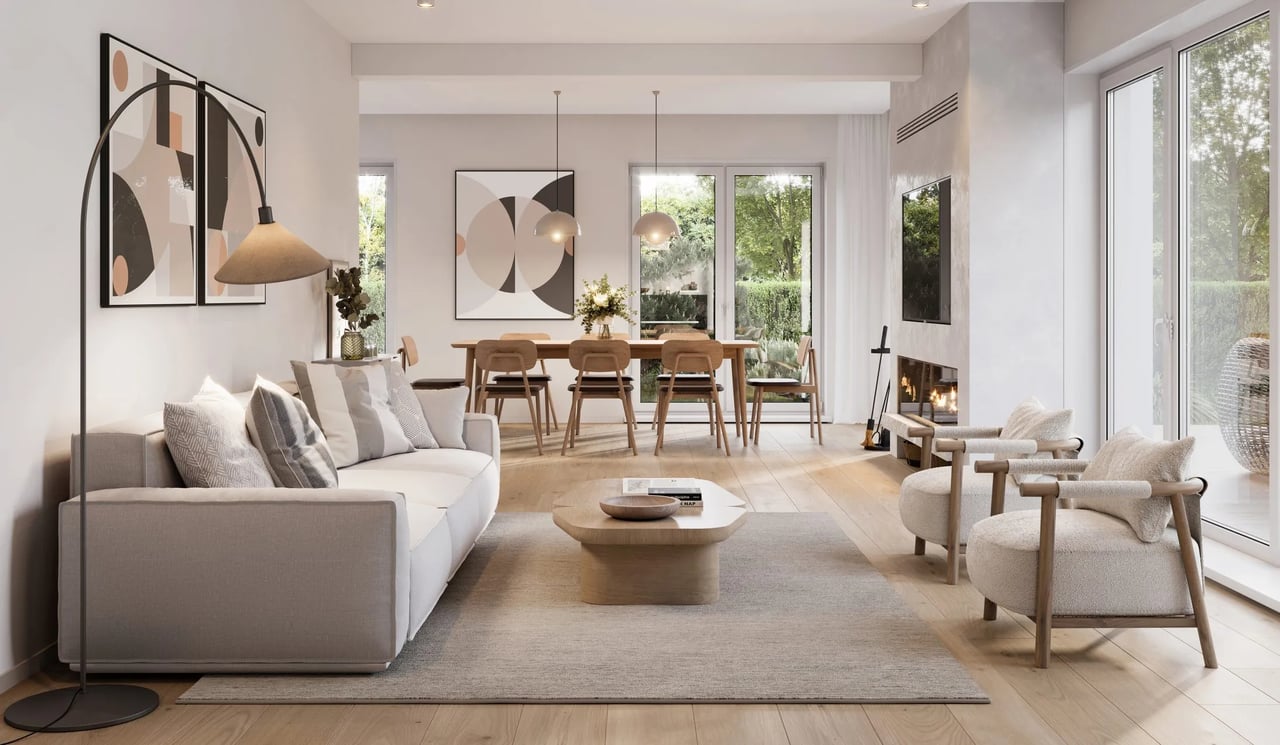
A home can look expensive without being worth substantially more. Designer lighting, dramatic countertops, luxury flooring, staging, furniture, and cosmetic renovations can create a powerful first impression. But market value is usually influenced by a broader combination of location, property type, usable square footage, layout, lot, condition, major systems, comparable sales, and current buyer demand.
The House That Looks Expensive but Isn’t Worth More
Why luxury finishes and beautiful presentation can influence your emotions more than the property's actual market value.
Some homes immediately feel expensive.
You walk through the front door and notice:
- Large designer light fixtures.
- Quartz or stone countertops.
- Wide-plank flooring.
- Custom-looking cabinetry.
- Beautiful furniture.
- Neutral paint.
- A professionally styled living room.
The home feels polished.
And without realizing it, a buyer can begin to make a mental jump:
“This house looks expensive, so maybe the asking price makes sense.”
That is exactly where buyers need to slow down.
A home can be beautifully presented without being correctly priced.
Visual Appeal
≠
Renovation Cost
≠
Asking Price
≠
Market Value
1. What the Seller Spent Is Not Automatically What the Market Will Pay
Sellers often invest significant amounts of money improving a home.
They may replace:
- Kitchen cabinets.
- Countertops.
- Flooring.
- Bathrooms.
- Lighting.
- Appliances.
- Landscaping.
Those improvements may absolutely increase buyer appeal.
But real estate does not operate according to a simple reimbursement formula.
Renovation Spend
≠
Dollar-for-Dollar Increase in Market Value
A seller may spend $50,000 improving a property.
That does not mean buyers will automatically pay $50,000 more for it.
The market still compares the finished property with the reasonable alternatives available to buyers.
2. Beautiful Materials Can Be Expensive Without Creating Equal Buyer Value
Some upgrades cost a great deal because of material selection, customization, or personal preference.
For example:
- Imported tile.
- High-end decorative lighting.
- Custom wallpaper.
- Specialty cabinetry.
- Designer plumbing fixtures.
A buyer may appreciate those features.
But another buyer may consider them mostly cosmetic.
Market value depends on what the broader relevant buyer pool recognizes and is willing to pay for—not simply the owner's receipts.
3. Staging Can Change How Expensive a House Feels
Professional staging can be extremely effective.
Good staging can help buyers understand scale, function, and how a room might be used.
It can also make a house feel more sophisticated.
But staging is presentation.
It is not part of the real property unless specific items are separately included in the transaction.
Mentally Remove
the Furniture, Art, Rugs, Lamps, and Decorations.
Then Ask:
“What am I actually buying?”
4. Location Still Sets the Competitive Context
A renovated house does not exist in isolation.
Buyers still compare it with other properties in relevant competing locations.
Important location-related factors may include:
- Road exposure.
- Commute patterns.
- Access to transportation.
- Nearby land uses.
- Parks and amenities.
- Lot position.
- Nearby development.
- Overall supply and buyer demand in that specific market.
A beautifully renovated home on a property with a permanent location trade-off may still need to compete on price with homes that have stronger location characteristics.
You can renovate a kitchen.
You usually cannot renovate the road behind the house.
5. Layout Can Matter More Than the Finish Level
A beautifully finished home can still have a difficult layout.
Ask:
- Are the bedrooms where I need them?
- Is there useful storage?
- Does the kitchen connect logically to the living spaces?
- Are there awkward transition areas?
- Can furniture be placed normally?
- Does the floor plan fit real daily life?
Buyers may initially notice the marble countertop.
They live with the floor plan.
Expensive Finish
+
Awkward Layout
Does Not Automatically Equal
Premium Value
6. More Square Footage Is Not the Same as More Useful Square Footage
A home may photograph as large because of:
- Wide-angle photography.
- Smaller staging furniture.
- Open floor plans.
- Tall ceilings.
But buyers should separate visual spaciousness from actual property size and function.
Consider:
- Actual finished space.
- How the square footage is distributed.
- Bedroom sizes.
- Storage.
- Basement usability.
- Ceiling height.
- Functional room placement.
7. A New Kitchen Does Not Tell You the Condition of the Whole House
Cosmetic renovations attract attention because buyers can see them immediately.
But some of the most expensive ownership items may be much less visually exciting.
For example:
- Roof.
- HVAC.
- Water heater.
- Plumbing.
- Electrical systems.
- Drainage.
- Foundation or structural components.
- Windows and exterior components.
A $30,000 kitchen does not tell you whether the roof is approaching the end of its useful life.
System age alone does not automatically mean something is defective.
A more complete evaluation considers:
Age + Condition + Maintenance History + Inspection Findings + Future Repair Exposure
8. Renovation Quality Matters More Than the Word “Renovated”
A listing may describe a home as:
Fully Renovated.
But that phrase does not tell you:
- Who completed the work.
- What was actually replaced.
- Whether work was mainly cosmetic.
- Whether plumbing or electrical work was involved.
- Whether permits were required and what records are available.
- Whether invoices or warranties exist.
A buyer should evaluate the scope and quality of the work rather than assuming that “renovated” automatically means “better.”
9. Lot and Parking Still Matter Even When the Interior Is Beautiful
Interior design can pull a buyer's attention away from permanent exterior factors.
Before deciding what the house is worth to you, look again at:
- Lot size.
- Usable yard.
- Slope.
- Privacy.
- Driveway.
- Garage.
- Guest parking.
- Road exposure.
- Neighboring properties.
These features may influence daily usability and future buyer acceptance in ways that expensive flooring cannot solve.
10. Comparable Sales Help Bring Emotion Back to Reality
Once a buyer falls in love with a house, comparable sales become especially important.
Good comps should generally try to match meaningful property characteristics such as:
- Location.
- Property type.
- Size.
- Bedrooms and bathrooms.
- Lot.
- Age.
- Condition.
- Basement or other functional space.
- Parking.
- Relevant location characteristics.
Perfect comps rarely exist.
The goal is not to find another house with the exact same backsplash.
The goal is to understand how the market has priced reasonably similar properties.
Feature | Easy to Notice | Potentially Important to Value Analysis |
|---|---|---|
Designer Light Fixture | Very | Usually secondary to major property characteristics |
Kitchen Renovation | Very | Can matter, depending on quality and competing homes |
Functional Layout | Sometimes | Often meaningful to buyer acceptance |
Lot Position | Easy to overlook | Can be significant |
Major System Condition | Not glamorous | Can affect buyer risk and ownership cost |
Road Exposure | Sometimes overlooked indoors | Can affect buyer acceptance and pricing |
11. Don't Use Price per Square Foot as the Only Answer
Price per square foot can be useful as one reference point.
But two homes with similar square footage may differ significantly in:
- Condition.
- Lot.
- Layout.
- Basement.
- Garage.
- Road exposure.
- Renovation quality.
- Property type.
Value analysis should usually be more nuanced than multiplying square footage by one neighborhood average.
12. A Seller's Asking Price Is Not the Same as an Appraisal
An asking price is a marketing decision.
It tells you what the seller is asking.
It does not independently establish market value.
Similarly, a comparative market analysis prepared by an agent and an appraisal performed by a licensed appraiser are different products with different purposes and methodologies.
Asking Price tells you what the seller wants.
Comparable Sales help you understand what the market has recently supported.
13. Personal Value and Market Value Are Not the Same Thing
There is nothing wrong with paying more for something you personally love.
Maybe the home has:
- The exact kitchen you wanted.
- A finished basement you will use every day.
- A lot that fits your needs.
- A commute that saves you substantial time.
Those things may have meaningful personal value to you.
The important part is understanding the distinction.
You Can Decide to Pay a
Personal Premium.
Just Don't Automatically Assume
the Market Owes It Back to You Later.
The “Expensive-Look Test”
If a home feels unusually luxurious, do this before deciding what you think it is worth.
☐ Mentally remove the staging.
☐ Ignore the light fixtures for a minute.
☐ Look at the actual floor plan.
☐ Look at storage.
☐ Look at the lot.
☐ Look at parking.
☐ Look at the neighboring properties.
☐ Look at the major systems.
☐ Ask what was actually renovated.
☐ Then compare it with recent relevant sales.
Separate the “Value Stack”
Layer | Examples | Buyer Question |
|---|---|---|
Presentation | Furniture, art, staging, decor | Would I feel the same if this were empty? |
Cosmetic Finish | Countertops, paint, lighting, flooring | How much premium does the market appear to support? |
Function | Layout, storage, bedrooms, parking | Does the home work well? |
Condition | Roof, HVAC, plumbing, electrical, structure | What ownership risk remains? |
Permanent Property Features | Lot, location, road, view, neighboring uses | Which trade-offs cannot be changed later? |
Market Evidence | Recent relevant sales and competing inventory | What are buyers actually paying for alternatives? |
15 Questions Before Paying a Premium for a Beautiful Home
☐ 1. What is making this house feel expensive to me?
☐ 2. Is that feature staying with the home?
☐ 3. What would the home feel like without the staging?
☐ 4. What was actually renovated?
☐ 5. What was not renovated?
☐ 6. How old are the major systems?
☐ 7. Is the layout actually functional?
☐ 8. Is the square footage truly useful?
☐ 9. How does the lot compare with competing homes?
☐ 10. Are there permanent location trade-offs?
☐ 11. What are the strongest recent comparable sales?
☐ 12. What current listings compete with this home?
☐ 13. How much of the asking-price premium appears supported by market evidence?
☐ 14. Am I paying for market value or personal preference?
☐ 15. If I had to resell later, which features would future buyers evaluate differently?
Frequently Asked Questions
Do luxury renovations increase home value?
They can increase buyer appeal and may support a higher market value, but the increase is not automatically equal to the renovation cost. The effect depends on the market, quality, property, buyer expectations, and comparable sales.
If a seller spent $100,000 renovating, is the house worth $100,000 more?
Not necessarily. Renovation cost and market value are different concepts. Buyers and appraisers evaluate the finished property relative to relevant market evidence rather than simply reimbursing the seller's improvement budget.
Is a renovated house always a better buy than an older-looking house?
No. Compare layout, condition, major systems, lot, location, renovation quality, ownership costs, and price. A less cosmetically updated home can sometimes provide stronger value depending on the property and buyer's priorities.
Can staging make a house seem more valuable?
Staging can significantly improve presentation and emotional appeal. Buyers should remember that staging itself usually is not part of the real estate being purchased unless particular personal-property items are separately included.
Should I use price per square foot to determine value?
It can be one reference point, but it should not usually be the only method. Homes with similar square footage can differ substantially in condition, lot, layout, property type, parking, basement, location, and other characteristics.
Is an older HVAC system automatically a reason to pay less?
Not automatically. Age is one factor. Condition, maintenance, inspection findings, remaining function, replacement exposure, and the property's overall pricing should also be considered.
Can a buyer intentionally pay above what comps suggest?
A buyer can decide that certain features have additional personal value, subject to financing and contractual considerations. The important distinction is understanding when you are paying a personal premium rather than assuming future buyers will necessarily recognize the same premium.
How can my agent help me determine whether the asking price makes sense?
An agent can analyze recent relevant sales, current competing listings, property condition, location, layout, lot, renovation quality, and other market factors to help you evaluate the asking price. A comparative market analysis is not a guarantee of appraised value or future resale price.
Don't Let Expensive-Looking
Automatically Become
Worth More
in Your Mind.
Final Thoughts: Buy the Property, Not the Presentation
There is nothing wrong with loving a beautifully renovated home.
Good design matters.
Quality finishes matter.
Presentation matters.
But when it is time to decide what you are willing to pay, separate emotional appeal from the underlying real estate.
Look at:
Location.
Lot.
Layout.
Usable space.
Parking.
Major systems.
Renovation quality.
Current competition.
And recent comparable sales.
A beautiful home can absolutely be worth a premium.
The important question is whether that premium is supported by the property and the market—or whether the house simply does an excellent job of looking expensive.
Love the House but Not Sure the Price Makes Sense?
We can compare the home with relevant recent sales and current competition, then look beyond the staging and finishes at location, lot, layout, usable square footage, major systems, renovation quality, road exposure, parking, and other property-specific factors. The goal is not to talk you out of a beautiful home—it is to help you understand what you are actually paying for.
Tina Jingru Sui | TJS Team
About Tina Jingru Sui
Tina Jingru Sui is the founder and leader of the TJS Team, serving buyers, sellers, investors, and relocation clients throughout Metro Atlanta.
Tina and her team serve communities including Atlanta, Johns Creek, Alpharetta, Suwanee, Duluth, Buford, Dacula, Marietta, Roswell, Sandy Springs, Smyrna, Lawrenceville, and surrounding Metro Atlanta areas.
Keller Williams Atlanta Partners · (404) 375-2120
This article is provided for general informational and educational purposes only and does not constitute legal, financial, lending, appraisal, inspection, investment, tax, construction, engineering, or other professional advice. Renovation cost does not guarantee an equal increase in market value, appraisal, future sale price, appreciation, buyer demand, or resale performance. Market value is influenced by multiple property-specific and market factors, and reasonable professionals or buyers may reach different conclusions. Comparative market analyses prepared by real estate professionals are not appraisals and do not guarantee an appraised value or sale price. Property age alone does not establish a defect, remaining useful life, or replacement requirement. Buyers should independently evaluate property condition through appropriate inspections and specialist evaluations where needed. References to renovation, permits, warranties, property boundaries, HOA matters, taxes, school assignments, nearby development, zoning, or other property-specific facts should be independently verified when material to a purchase decision. When school assignment matters, buyers should verify the exact property address through the appropriate official school district because boundaries can change. Staging, furniture, art, and personal property are not automatically included in a real estate transaction unless specifically agreed upon. No property feature, renovation, neighborhood, comparable-sale analysis, or marketing strategy guarantees future value, appreciation, marketability, or resale results. Community and location comparisons should rely on objective property and lifestyle criteria identified by the consumer and not on characteristics protected by Fair Housing law. Equal Housing Opportunity. Tina Jingru Sui, GA License #392936, REALTOR®, affiliated with Keller Williams Atlanta Partners and regulated by the Georgia Real Estate Commission.




